

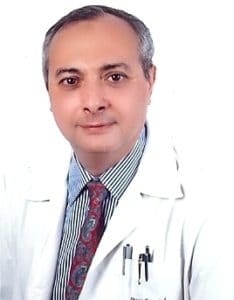
 Wael M.S.A. Gawad, MD, PhD
National Cancer Institute NCI-Cairo University, Egypt
What are the unique challenges your institution faced since being confronted with the pandemic?
Our institution is a tertiary referral center where almost all advanced and technically challenging difficult cases are treated. Given the remarkable number of referred complicated cases, the major challenges were to prioritize and reschedule patients according to their surgical urgency based on disease site and stage either in OR or outpatient basis.
Meanwhile, screening suspected patients, including medical staff, has had a financial and psychological burden. Dissociation of patients from their families has a major psychological negative impact on patients and medical staff.
How did hospital administration tap into surgical oncology staff to support COVID-19 patients?
- Provide logistic technical communication with patients in the form of virtual clinics.
- In order to decrease exposure, redistribution of the surgical staff and on-call rotations so that only the minimal number of staff are available to serve patients.
- Provide the necessary PPE, whether in wards, OR or ICU for the staff.
- Resuming surgical meeting-MDT and educational sessions through webinars and online media.
How has the pandemic changed your cancer patient treatment regimens? Have you had to delay many surgeries?
- Emergency cancer surgeries only were conducted, including obstructed colonic or rectal cancer, HBP cancers and advanced head and neck cancers.
- Shift to neoadjuvant therapy whenever possible including breast cancer, total neoadjuvant therapy in rectal cancer and stenting and neoadjuvant therapy for obstructed rectal cancer.
- Delay of elective cases such as CRS & HIPEC for 3 to 6 months with possible alternative chemotherapy.
- Defer well-differentiated thyroid cancer patients 3 to 6 months.
- Abandoned all MIS to abolish the possibility of aerosoling.
- Vigilant follow up with patients through virtual clinics to detect any changes in their status that might require intervention
What is your current case volume (%) of cancer surgeries and what type of procedures are you doing? Where do you think you are on the curve – and how do you see it changing over the coming weeks?
- Compared to pre- COVID-19 era, it is almost the emergency and urgent cases that are done nearly 35 % of our routine practice.
- Emergency or urgent cases as obstructing colonic cancer, pancreatic cancer, locally advanced thyroid and H & N cancers and renal tumors.
- Still, we are in the peak of a vertical curve but last week we started to notice the beginning of horizontal stationary course.
Can you share some of the personal and professional challenges you have faced during these unprecedented times?
- Proper patient selection for management.
- Screening for all patients admitted or scheduled for OR 72 hours before surgery.
- Strict Precautions for suspected or Proven COVID19 patients through PPE.
- Should any member of the medical team feel any symptoms –self isolation and Screening is mandatory.
- Fear and avoidance of part of the community to communicate with the medical staff treating COVID 19 cancer patients with the illusion of virus transmission.