

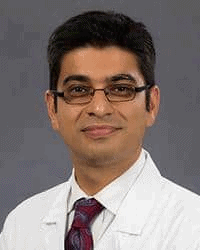
 The SSO Clinical Investigator Award was initiated in 2007 with the objective of supporting early to mid-career investigators, with a track record of peer-reviewed research funding, to further clinical cancer research. SSO’s Research Grant Program is supported by the SSO Research and Education Fund, a restricted fund of the former SSO Foundation. Since the inception of the award, $3.6 million in funding has been distributed to 36 recipients. “Evaluation of the Effect of Gut Microbiome Composition on Response of Colon Cancer Metastases to Systemic Therapy” was the 2020 Clinical Investigator Award-winning proposal submitted by Vikas Dudeja, MD.
Q: What is the focus of your research and how did it begin?
A: As a surgeon scientist, my lab has been studying the basics of pancreatic cancer and other hepatobiliary cancers, like liver cancer and bile duct cancer. Our lab has previously shown that the gut microbiome can modulate or even promote growth of various cancers. In other words, if we treat mice that have cancer just with antibiotics, the tumor growth is affected. We are not giving them any chemotherapy, or any other kind of anti-cancer therapy. We have also shown in our preliminary studies that changing the gut microbiome can also affect the response to chemotherapy. Based on this, we have hypothesized that “gut microbiome will help us predict and modulate response to chemotherapy.”
Currently we are collecting stool samples from patients, before they start chemotherapy and then we are monitoring the response of that particular person to chemotherapy. In the end we’ll analyze if the gut microbiome can predict the response to chemotherapy. There’s a lot of emphasis on personalized medicine and a patient’s gut microbiome will help us decide if certain therapy will be effective or not. In other words, if we were to understand which bacteria induce resistance to chemotherapy, it has two-fold implications. First, we could predict if a patient has the “bad” bacteria which induces resistance to chemotherapy, he or she will not respond to chemotherapy. Another amazing possibility and the future direction for this research is that if we get rid of the “bad” bacteria, with antibiotic, pre-biotic or pro-biotic, we believe that patients, who were initially resistant to a particular chemotherapy, will start responding to chemotherapy.
Q: Why in particular did this topic intrigue you enough to want to explore more?
A: We were interested in figuring out how the immune system affects cancer. There’s a lot of understanding right now about the role of the immune system in shaping outcomes for cancer, as well as cancer therapies. Now, the interesting part is that the gut microbiome, or bacteria in our gut, helps shape the immune response. And this is clear from many different studies. So that is why we were interested in evaluating the role of gut microbiome in cancer progression. We basically proposed that the gut bacteria are sending signals which go to the liver and then help shape the immune response. That’s basically how the project started.
One of our earliest experiments was that we depleted the gut bacteria with antibiotics and evaluated whether the growth of the tumor in the liver changed. Eventually we found out that not only the tumor growth in the liver changed, but it also changed everywhere – it was not only controlling the liver, but everywhere else.
Q: When do you anticipate that this phase of your research will be completed and what’s next?
A: We will be collecting gut microbiome and evaluating patient response to chemotherapy over next 4 years. In two years’, time, we will do an interim analysis and will have some direction with respect to the results of our study. Alongside, we are taking the human gut microbiome and putting it in mice so that the gut microbiome of the mice becomes the same as that of patients. And we are calling them “Human AVATAR mice”. And then we are putting tumors in them. Now, in this aspect of the project, we are giving these AVATAR mice with tumor, chemotherapy, with or without antibiotics, to see if we can identify a certain bacteria or certain antibiotics which can change response to chemotherapy. After that comes the next phase, where we will design a clinical trial where patients are given antibiotics in combination with chemotherapy.
The gut microbiome can affect so many disease processes, including cancer, and by changing the gut microbiome we can really change the outcome of the patient – that’s what this research is focused on.
First and foremost, I want to thank our patients who teach us so much. I would also like to express my sincere gratitude to my mentors. I’d like to thank postdoctoral fellows and research associates in my lab. It is their relentless hard work which has made all this work possible. Last but not the least, this work will not have been possible without the funding support from Society of Surgical Oncology, National pancreas foundation, Department of Surgery at U Miami, Sylvester Comprehensive Cancer Center and other funding agencies like NIH, Department of Defense, VA Merit Award and Florida Biomedical Research Program.
SSO’s Research Grant Program is supported by the SSO Research and Education Fund, a restricted fund of the former SSO Foundation. The availability of research grant funding is dependent on the financial support of SSO members and donors. Please donate generously to ensure that SSO members have an ongoing source of funds for research projects and 100% of your donation supports this program.